I’ve been running Mythic Bastionland as an open table game. Each session, I put out a call for players from a pool of eight to see who has availability to jump on Discord for two hours and roleplay as knights of the Realm. If I have even one player, we play. The stable of knights has grown with new players and shrunk with unfortunate endings. But the range of ages, glory, possessions, and connections is vast among the player characters. You have young ones starting out alongside old knights, some successful, some not so much. All together for an adventure to seek the myths, honor the seers, and protect the realm.
I might write more about the open table setup for MB. The drop-in, drop-out nature works wonders for vignette knightly storytelling and busy schedules.
With a new grouping of knights each session, I wanted a quick luck table to determine their starting position instead of either letting the players pick all the time and have an easy time of where the story starts and where they want to go or picking where the story picks up and having it be completely my decision. So bring out the dice!
At the beginning of the session, roll d6 to determine the company’s starting position:
1 - The company is in a bad spot. Roll d12 and d12 to determine their placement on the Realm map. Roll to see which task they are engaged in when their luck turns sour.
2-3 - The company is nearing the end of a task for the Realm. They are two hecksleagues away from a random holding. Roll to see which task they are almost done with.
4-6 - The company chooses which holding to start their adventures at. Roll to see which task they just finished.
SPRING TASKS
1. Collecting Tax (coin)
2. Dealing with dangerous weather (wind, cold rain, flooding)
5. Protecting a caravan (displaced vassals, royalty, merchants)
6. Fending off predators (beasts, beastmen, mythicals)
HARVEST TASKS
1. Collecting Tithe (food and drink)
2. Dealing with dangerous weather (heat waves, thunderstorms, wildfires)
3. On patrol following a scare
4. On guard for a hunt
5. Settling a dispute between vassals
6. Doing a Seer’s bidding (always odd)
WINTER TASKS
1. Collecting Levy (materials and goods)
2. Building winter shelters
3. Investigating a missing vassal
4. Collecting firewood and supplies
5. Seeking a Seer’s audience
6. Delivering a message
Some Mouse Guard influence here: sworn knights doing mundane tasks based on the season. Sprinkled in connections to holding rulers (collecting tax, tithe, and levies), the weather, enemies, peasants, and the seers. All knightly stuff, very easy to expand on or swap out your own ideas. :)
…I wrote an anticipatory piece about a little video-game called No Man’s Sky. Back then—ten years ago, eek!—No Man’s Sky seemed more of a vision of the future of video-games than something concrete. We were all enraptured by the idea of infinite exploration, a living universe populated by the unbridled creativity of algorithmic chance. And then came the fall—the disastrous release of No Man’s Sky that garnered it such negative reviews and perception.
It would be pointless for me to write about this, or indeed No Man’s Sky’s epic recovery and transformation into potentially the most beloved sci-fi exploration game of all time. Many other writers and journalists have covered this topic in extensive and sometimes hands-on detail with the developers, so there is very little I can add.
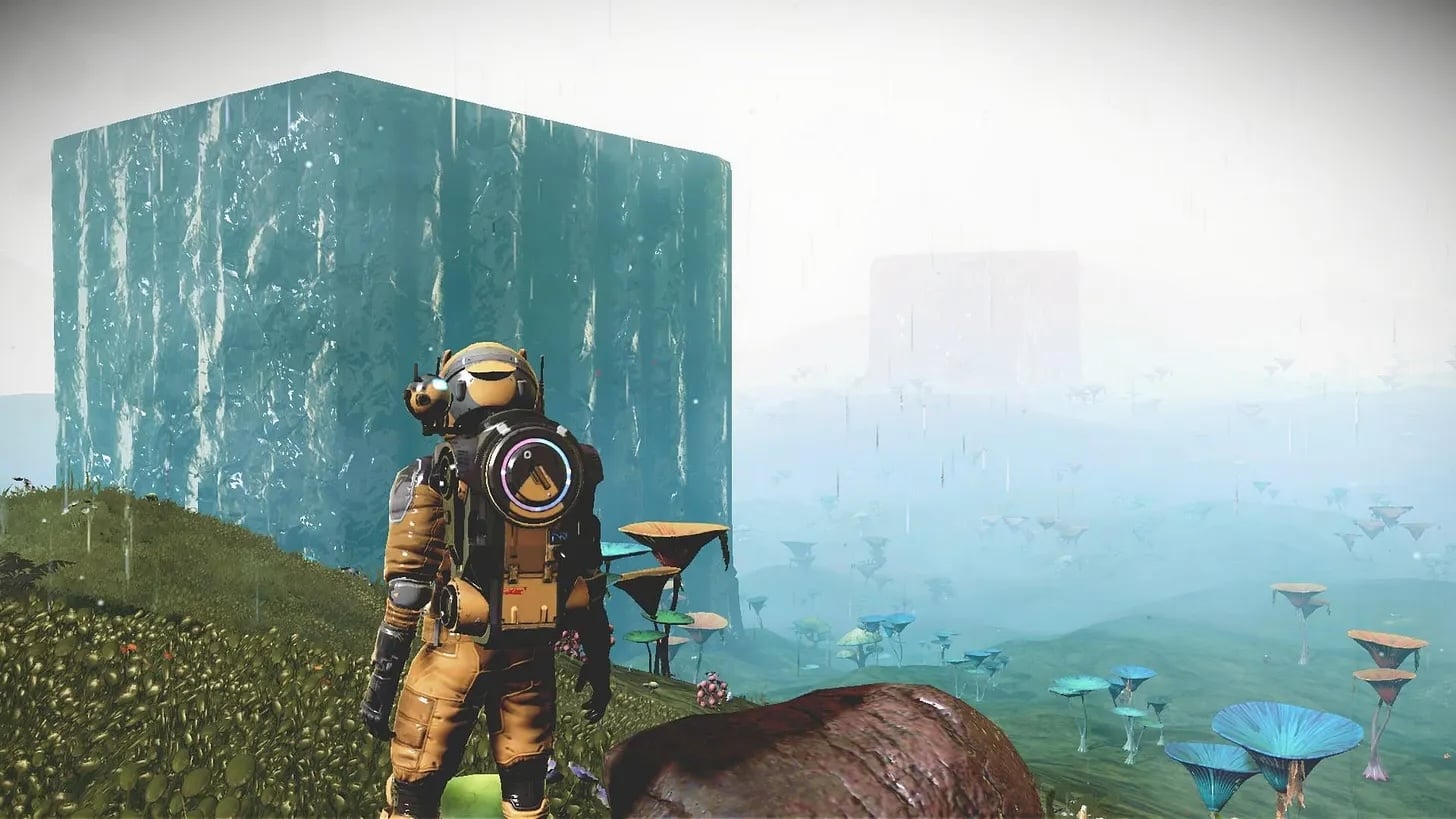
What I do want to share is how, ten years later, No Man’s Sky still manages to feel fresh. Slipping back into the game feels like walking back into a bright dream. There is an energy about it. A ferocious clarity of vision. And I think the core of this is something that we writers, artists, and creatives can learn from.
There are two intertwined elements that make No Man’s Sky such an immersive and, frankly, addictive experience.
The Glorious Vicissitudes of Chance
The first I have alluded to already: chance. The randomness of the worlds creates a feeling of personal discovery that is intoxicating. This is something we writers, in particular, often forget. The visual artist intuitively understands that the accident of a brushstroke, or a combination of colour, can create revelation. Glass-makers literally do not know how their final composition will appear, for in the firing process colours change, structures shift, and the whole warp and weft of the thing transforms. There is an element of randomness, of chaos, inherent in the art-form, and a part of its joy.
Rolling the Die
We writers, by contrast, tend to believe in working everything out logically. Yes, we receive surprises when our characters misbehave, but rarely do we leave anything to chance.
But sometimes, chance is what a story needs. Sometimes, rolling a die to see whether a character lives or dies, or where a party of explorers end up next, is exactly what a story needs to take some unprecedented leap into the unknown. I have used this technique, particularly with my GameLit / LitRPG series Levi’s Game, where certain locations and creations were procedurally generated.
We receive surprises when our characters misbehave, but rarely do we leave anything to chance.
Joseph Sale
I did this because the locations actually are procedural in the story, so it felt fitting to reflect this in the creative process and challenge myself—and my characters—with an unexpected outcome. Incidentally, if you’re curious about how this turned out, the first book in the series has recently been released on audiobook. Check it out here.
But procedural generation can be applied in any number of ways. Once you start thinking more like a Dungeon Master and less like a writer, you begin to realise that storytelling is pure play, and randomness becomes not your enemy, but a way of accessing previously inaccessible powers of surprise.
The Depth of Mystery
The great David Lynch once said, “The more unknowable the mystery, the more beautiful it is.” And he is absolutely right. Human beings are called by the siren-song of mystery. We yearn to know the unknowable. Nothing intrigues us more than a riddle that seemingly has no answer. It is why Mystery fiction will remain evergreen.
Mystery is the second—and far less talked about—element that No Man’s Sky gets right. We awaken on a strange world with no memory of who we once were, only the stark reality of a destroyed ship, limited supplies, and the will to survive. However, it seems there is some kind of benevolent force in the universe, for we are given clues in the form of cryptic messages, guiding us back to the true path and towards some ultimate destiny.
We know so little, at the start of our journey. And the more we find out, the less it seems we know. There is a species called the Gek who leave ancient standing stones, imparting knowledge of their language to explorers. Why? There are robotic sentinels patrolling some planets and protecting their bio-diversity. Why? Were they left behind by some colossal civilisation now undone? Every answer prompts a new question. But most mysterious of all is the question of our own nature of why we are called to strive, survive, and reach the stars. It is an unanswerable mystery. The heart of the human condition itself. And somehow, impossibly, No Man’s Sky captures this.
Stepping Into the Unknown
As writers, we tend to want to explain our reasoning, to provide motivations for our characters, to ensure our plots hang together logically. I am not advocating we abandon this entirely. But what No Man’s Sky—and indeed the great masters of literature—teach us is that mystery must prevail. Without mystery, there is nothing to compel the human imagination. The unknown is not to be feared; it is our natural habitat. If we are to inspire and ensoul the world, we must go forth into that vast dark without fear, without caution, and fully embrace the divine mystery of the universe, for it is only in embracing the mystery that we can finally embrace ourselves.
Joseph Sale
Joseph is the author of more than 30 books, including The Book of Thrice Dead, Virtue’s End, Dark Hilarity, and The Claw of Craving. He is drawn to the baroque, the spiritual, and the mythic like a moth to flame.
He lives in the south of England with his wonderful family, where he obsesses over table-top RPGs, trading card games, book bindery, esoteric Christianity, and anime.